
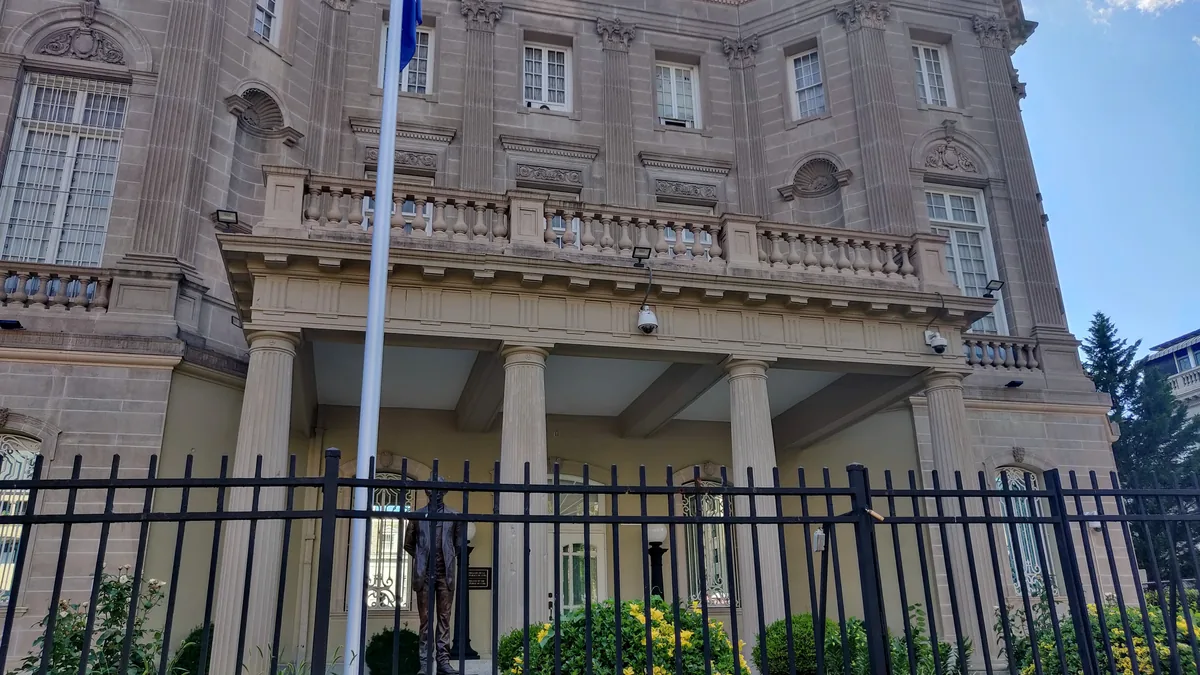
Cuba provides consular services in the United States from exactly one office: the consular office of the Embassy of the Republic of Cuba in Washington, D.C. The Embassy’s consular-services page, read October 15, 2026, lists that single consular office for Cuban citizens and applicants throughout the United States. The United States severed diplomatic relations with Cuba on January 3, 1961, according to the State Department’s Office of the Historian.
From September 1, 1977, the date the State Department’s Foreign Relations of the United States record gives for the opening of the Interest Sections, until 2015, the diplomatic interests of Cuba in the US were represented through the Cuban Interests Section of the Embassy of Switzerland in Washington (Cuba lacked formal embassy status during that period). On July 20, 2015, after the Obama-era restoration of formal relations, the Cuban Interests Section was upgraded to the Embassy of the Republic of Cuba. The Embassy’s consular section now handles all consular services for Cuban nationals living in any US state or territory.
Embassy of the Republic of Cuba — verified contact information
| Item | Detail |
|---|---|
| Mission type | Embassy with consular section (only Cuban consular office in the US) |
| Consular office (in person) | 2639 16th Street NW, Washington, DC 20009 |
| Embassy / postal mail address | 2630 16th Street NW, Washington, DC 20009 |
| Consular section phone | (202) 797-8518 (inquiries Mon–Fri, 9:00 AM – 5:00 PM) |
| Email (consular reception) | recepcion@usadc.embacuba.cu |
| Official website | misiones.cubaminrex.cu/es/eeuu |
| How to request a service | In person, by postal mail, or through an agency under contract with the consular office. The consular-services page names no online booking portal (checked October 16, 2026) |
| Jurisdiction | The page names a single office address (2639 16th St NW). It says “La mayoría de los servicios que ofrecemos a cubanos residentes en Cuba y en Estados Unidos, se pueden solicitar por 3 vías” and lists no states, counties or territories (checked October 16, 2026) |
| Last verified | 2026-10-10 for the consular office address, mailing address, consular phone, e-mail, hours, request channels and mail/agency rules (consular-services page of the Embassy of Cuba); 2026-08-07 for the other rows |
Consular services offered
The Washington office’s consular-services instructions also specify (checked October 16, 2026):
- Passport-renewal photos: two high-resolution color passport photos, with a light background, facing forward, face and head uncovered and no dark glasses.
- Renewal-form signature: children under 16 and people with disabilities are exempt from signing.
- Minor’s passport and travel authorization: one document cannot authorize two children; both parents may make a single document for one child.
The Cuban Embassy consular section in Washington provides the following services to Cuban citizens in the US:
- Cuban passport renewal and issuance (since July 1, 2023 the passport is valid 10 years for holders 16 or older and 5 years for those under 16, with no two-year extensions). As of October 15, 2026 the consular-services page lists $180 for applicants over 16 and $140 for those under 16, paid by Postal Money Order, plus $20 for a request sent by mail and a separate $5 Postal Money Order; see the Cuban passport renewal guide
- HE-11 entry authorization (Habilitación de entrada con pasaporte extranjero) — not a visa for non-Cuban travelers. The consular-services page, read October 15, 2026, says people who emigrated before January 1, 1971 and travel with an HE-11 must present their Cuban passport to enter Cuba (see the HE-11 note below)
- A-2 visa (listed among the services for foreigners) — for foreign (non-Cuban) spouses and children of Cuban citizens who intend to travel to Cuba with them
- Birth registration for children born in the US to Cuban citizens
- Marriage and death registration for events that happened in the US
- Cuban civil-registry and criminal-record certificates requested from the US
- Power of attorney for Cuban legal proceedings
- Consular legalization of documents — Cuba is not a party to the Hague Apostille Convention, so documents are legalized by the consulate rather than apostilled
- Emergency travel document and repatriation (returning to live in Cuba)
Source: the consular-services page of the Embassy of Cuba (Spanish version) and Resolución 38/2023, checked October 3, 2026; Hague status from the HCCH Apostille Convention status table.
Citizenship for children born abroad and the HE-11 permit (read October 15, 2026)
- Cuban citizenship for children of Cubans born abroad. The consular-services page says that since January 2018 this can be requested from Cuban consulates abroad without traveling to Cuba. The process starts with the transcription (registration) of the child’s birth; the Cuban birth certificate that results is then presented at the consulate with the application form that fits the case (Annexes 17 to 20: adult, minor or legally incapacitated person, one parent presenting, or a third person). It is filed in person or through a contracted agency, not by mail. The page says this service has no assigned fee (Este servicio no tiene arancel asignado) and that an answer is due within 90 business days of sending the application. Our guide to registering a US-born child covers the first step.
- HE-11 entry permit. The same page says the HE-11 is authorized by Cuba’s Dirección de Identificación, Inmigración y Extranjería, is valid for a single entry of 90 days from arrival, and that those 90 days can be extended when justified. Under the migration measures in force since July 1, 2023, which cite the 2019 Constitution, people who emigrated before January 1, 1971 must present their Cuban passport to enter Cuba.
Why there is no Cuban consulate in your US city
You may find references in older directories, Wikipedia, or third-party sites to “Cuban consulates” in cities like Miami, New York, Los Angeles, Chicago, Houston, New Orleans, San Francisco, Tampa, and others. These references are historical — those consulates closed in 1961 when US-Cuba relations were severed during the Eisenhower administration following the Cuban Revolution. They have not reopened in the more than six decades since.
The United States and Cuba resumed diplomatic relations on July 20, 2015, when both countries elevated their Interests Sections to Embassy status (Office of the Historian). The consular-services page, read October 15, 2026, still lists a single consular office, in Washington, for the whole country, so consular services for Cuban nationals in any US state are handled through it.
What to do if you live far from Washington, D.C.
Cuban nationals living outside the Washington metro area have three options:
- Travel to Washington, D.C. for in-person services. The consular office’s services page, read October 10, 2026, says that most of its services can be requested through any of three channels: in person, by postal mail, or through a contracted agency (“La mayoría de los servicios que ofrecemos […] se pueden solicitar por 3 vías”). Passport renewal is one of them. The exceptions it names are listed below.
- Apply by postal mail, or through an agency under contract with the consular office. These are the two channels the consular office publishes alongside in-person service; the consular page lists a $20.00 USD non-personal-procedure charge (“trámite no personal”) procedure by procedure, only where it names that charge for the procedure and the channel used. Contact the consular office to confirm which agencies hold a current contract before paying anyone.
- Use a Cuban consulate in a third country while traveling abroad. Cuba’s missions in other countries are listed on the Cuban Foreign Ministry missions site linked under Related resources below.
Requests by mail or through an agency: the consular office’s rules (as of October 10, 2026)
The consular-services page of the Embassy of Cuba, read October 10, 2026, sets these rules (quoted in Spanish, our translation):
- Payment by mail: USPS Postal Money Orders only. “Si utiliza otro giro postal, su trámite será devuelto” (“If you use another money order, your request will be returned”). The page says the consular office cannot accept any other form of payment for personal procedures.
- Return envelope: put a prepaid return envelope inside the envelope that carries your request, one per applicant when a family applies together, and leave it unsealed. The page recommends envelopes with a tracking number.
- Where to mail: Embassy of the Republic of Cuba, 2630 16th St NW, Washington, DC 20009. In-person service is at 2639 16th St NW.
- Not accepted by mail: the authorization for a minor’s passport and travel abroad “solo se realizará si la solicitud se efectúa de manera presencial o a través de las Agencias que tienen contrato con el Consulado” (only if requested in person or through the agencies under contract with the consulate). A first-time passport application is likewise accepted only in person or through a contracted agency, and the page sets that route for these cases: “En caso de pérdida del pasaporte, poseer un pasaporte vencido de carátula gris, o un pasaporte ordinario (de color azul) emitido antes del 1 de enero de 2010, o no poseer ningún pasaporte cubano vencido que mostrar, mientras haya salido de Cuba antes del 1 de enero del 2014, debe realizar su solicitud de pasaporte por primera vez, a través de la vía presencial, o a través de alguna de las Agencias que tienen contrato de trabajo con la Oficina Consular.” (in case of a lost passport, an expired gray-cover passport, an ordinary blue passport issued before January 1, 2010, or no expired Cuban passport to show, provided the applicant left Cuba before January 1, 2014, the first-time passport application must be made in person or through one of the agencies under contract with the consular office; page checked October 10, 2026).
- Which passports can be renewed: the expired or expiring passport must have an issue date on or after January 1, 2010.
- Contracted agencies: the page links downloadable lists of agencies under contract with the consular office for 20 jurisdictions: California, District of Columbia, Florida, Georgia, Idaho, Illinois, Kentucky, Louisiana, Maryland, Massachusetts, Nebraska, Nevada, New Jersey, New York, North Carolina, Pennsylvania, Puerto Rico, Tennessee, Texas and Virginia. MigrantUSA has no relationship with any agency and receives no compensation from any link on this page.
Hours and visit protocol
- Consular office public hours: Monday–Friday, 9:00 AM – 12:00 noon (in-person services resumed under the consular office’s Informative Note No. 1/2024)
- Telephone inquiries: Monday–Friday, 9:00 AM – 5:00 PM at (202) 797-8518, or recepcion@usadc.embacuba.cu
- Photo ID required: government-issued ID (US driver’s license, US passport, US permanent resident card, or Cuban passport), as listed when this item was last checked on 2026-08-07
- No online appointment portal is named on the consular-services page (checked October 16, 2026). The consular office publishes three channels for requesting a service: in person at the consular office, by postal mail, or through an agency under contract with the consular office
- Payment: fees are charged per procedure. The consular page adds a $20.00 USD non-personal-procedure charge only where it names one for that procedure and channel (for example, passports requested by postal mail); it states that the Cuban citizenship application, filed in person or through a contracted agency, has no fee assigned
What the consulate’s own site says (checked October 16, 2026)
These fees and rules come from the consular-services page, checked October 16, 2026. The “trámite no personal” fee is the $20.00 surcharge the page charges on postal-mail requests and on some requests made through an agency.
- First-time passport: paid in two steps.
- First, a $20.00 identity-verification payment, which applies “si se realiza la solicitud a través de Agencias”.
- Then, once the applicant is identified as a Cuban citizen, $180.00 (over 16) or $140.00 (under 16), plus $5.00, paid separately.
- Travel and transit document (DVT): $140.00 by mail ($20.00 request, $20.00 non-personal fee, $100.00 issuance), or $120.00 in person. Exceptionally, a citizen classed as “Residente en el territorio nacional” whose passport is lost, damaged, stolen or expired and who must travel to Cuba immediately may receive a DVT instead of a new passport; holders classed as “Residente en el Exterior” or “Emigrado” with a documented humanitarian reason may also apply. It is issued after consultation with the DIIE and is valid for a single entry within 30 days of issue.
- HE-11: $20.00 request fee, plus $20.00 if sent by mail. If approved, $130.00 for issuance.
- Permanent residence in Cuba (return to live): $20.00, plus $20.00 if sent by mail. After the consulate notifies the applicant, the applicant must travel to Cuba “en un término máximo de 180 días” and go to the DIIE office of the municipality where they plan to live.
- Documents requested from Cuba: $20.00, plus $20.00 if sent by mail. When the documents arrive, the applicant is contacted for the payments that apply:
- $100.00 for authentication by the issuing Cuban institution
- $40.00 for MINREX legalization
- $40.00 for consular legalization
- the certificate fee: $100.00 for birth, criminal-record, marriage, divorce, death or single-status certificates; $50.00 for legal capacity to marry; $180.00 for nationality, foreigners’ registry or citizenship certificates
- Birth transcription: the act itself is fee-exempt. The legalizations are charged: $140.00 for the original certificate and $140.00 for the Spanish translation, plus $20.00 if sent by mail. Only acts and events “ocurridos dentro de la jurisdicción de dicha Oficina” can be transcribed there.
- Marriage transcription: $140.00 for legalizing the original, $140.00 for the translation and $140.00 for the transcription, plus $20.00 if sent by mail.
- Death transcription: since COVID-19, the related legalizations are exempt “de forma excepcional y hasta nuevo aviso”.
- Minor’s passport and travel authorization: in person or through contracted agencies only.
- At the office: $150.00.
- Through an agency: each legalization is $140.00, plus a $20.00 non-personal fee.
- Legalization of US documents for use in Cuba: $140.00 for the original and $140.00 for the Spanish translation, plus $20.00 if sent by mail.
- Envelopes and money orders: the page recommends tracked envelopes and a 9.65 USD postage stamp. Money orders must be filled out without crossings-out or smudges, in black or blue ink.
Cuba’s new Migration Law (Ley 171, published in the Gaceta Oficial on May 5, 2026; it enters into force 180 days after publication) lets Cuban residents abroad who arrive in Cuba with an expired passport, or one with no pages left, apply for a new one at Interior Ministry processing offices or through authorized law offices (Article 152.1), and its fifth transitional provision keeps current migration document taxes and consular fees in force until new regulations set them. In an interview MINREX published on July 21, 2026, the Interior Ministry says passport validity stays at 10 years for people over 16 and five years for younger people. Details and sources: Cuba’s 2026 migration laws.
Related resources
- Other diplomatic missions of Cuba worldwide: misiones.cubaminrex.cu
- US State Department on US-Cuba relations: state.gov — Cuba
- Know Your Rights — what to do if ICE detains you
- Other Spanish-speaking country consulates in the US
Information current as of 2026-10-10 for the consular office’s address, phone, e-mail, hours, request channels and mail/agency rules (checked on the consular-services page of the Embassy of Cuba); other items as of 2026-08-07. The Embassy of the Republic of Cuba in Washington, D.C. is the sole Cuban consular office in the United States; there are no Cuban consulates in any other US city. This page is general information, not legal advice — consult an immigration attorney for your specific situation.
Consular procedures — step-by-step guides
The most common services at this consulate (full step-by-step guides):