
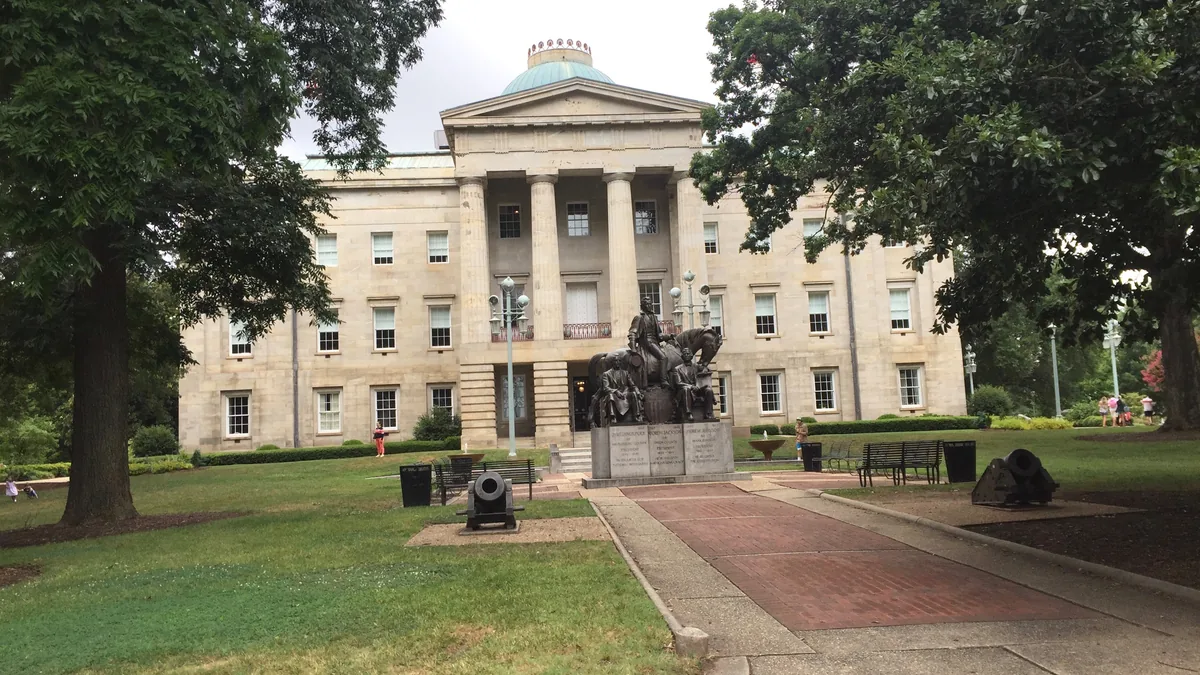
Learning English in North Carolina — resources for immigrants
North Carolina at a glance
North Carolina is home to about 973,325 foreign-born residents (9.1% of the state’s 10,730,404 people) and 1,213,850 residents of Hispanic or Latino origin (11.3%), per the U.S. Census Bureau’s American Community Survey (2024 5-year estimates). The procedures below apply to everyone in North Carolina regardless of immigration status unless noted.
Learning English opens doors: better jobs, communication with doctors and authorities, citizenship exam, daily life. Here are the best FREE or low-cost options in North Carolina.
| Adult English classes in North Carolina — official numbers (program year 2023-24) | |
|---|---|
| Adults in English classes | 22,196 adults took federally funded English classes in North Carolina: 20,371 in standard ESL and 1,825 in combined English + civics classes (IELCE) |
| Full state program | 46,587 total adult-education participants (includes GED/HiSET prep) — English learners are ~48% of the program |
| You're not alone | 489,594 North Carolina residents (4.9% of the 5+ population) speak English "less than very well," per the Census Bureau (ACS 2023) |
| Most-spoken languages | Besides English, the languages most spoken at home in North Carolina are Spanish (841,347 speakers) · other Indo-European languages (107,683 speakers) · other Asian/Pacific languages (83,560 speakers) |
| Measured results | 49% of ESL students in North Carolina advanced at least one measurable English level during program year 2023-24 |
| Find a class | literacydirectory.org — the National Literacy Directory ZIP-code search · or dial 2-1-1 (Spanish available) |
Funded classes cover about 1 in 22 of North Carolina's limited-English residents, so seats exist but fill fast — apply to more than one program.
Source: National Reporting System for Adult Education (NRS, U.S. Department of Education), Table 3, program year 2023-24; U.S. Census Bureau, ACS 2023. These classes are WIOA Title II funded, free or low-cost, and do not require immigration status.
Free ESL/ELL programs in North Carolina
Community Colleges
Community colleges and adult-education programs in North Carolina may offer free or low-cost Adult Education / ESL classes (verify availability and cost with the institution):
- Open enrollment year-round (no SAT, transcripts, or SSN required)
- Multiple levels (basic, intermediate, advanced)
- Flexible schedules (morning, afternoon, evening, weekends)
- Some offer HiSET/GED prep in Spanish or English
Search “Adult Education” + name of community college in your area.
Public libraries
Many libraries in North Carolina offer:
- Free group ESL classes
- Conversation circles (informal English chat)
- Free software access: Rosetta Stone (at many libraries), Mango Languages, Pronunciator
- ESL books to check out
Nonprofit organizations
- Catholic Charities - ESL programs at parishes in many cities
- YMCA / YWCA - adult ESL classes at some branches
- Local churches - especially Latin churches have ESL ministry
- Lutheran Services, Jewish Family Services - social services including ESL
- Worker Centers - day-worker centers with classes
State / local programs
- North Carolina’s WIOA Title II adult-education program — 22,196 adults took its English classes in program year 2023-24; find the nearest provider via literacydirectory.org
- WorkSource centers (many states) - employment-focused ESL
- Refugee resettlement agencies (if refugee/asylee): International Rescue Committee, Lutheran Immigration
Free online resources
- Duolingo - free app, 5-15 min/day, in Spanish
- BBC Learning English - free BBC site with Spanish-speaker lessons
- USA Learns - Department of Education site, free, specifically for adult immigrants
- VOA Learning English - simplified English news
- YouTube: channels like “English with Lucy”, “Speak English with Mr. Steve”, “English Like a Native”
ESL for citizenship exam (N-400 / Civics)
To naturalize you need:
- Speak basic English with USCIS officer
- Read 1 of 3 sentences correctly in English
- Write 1 of 3 sentences correctly as the officer dictates
- Civics exam: for an N-400 filed on or after October 20, 2025, 20 questions from a list of 128 with 12 correct to pass (the 2025 test USCIS publishes at uscis.gov/citizenship); N-400s filed before that date take the 2008 test — up to 10 questions from a list of 100, 6 correct to pass; USCIS says the officer stops asking once you answer 6 correctly or 5 incorrectly
Those are the standard requirements. USCIS says that if you are 65 or older and have lived in the United States as a lawful permanent resident for 20 or more years, you take a civics test of 10 questions from a specially selected bank of 20, and you may take the naturalization test in the language of your choice.
Specific citizenship prep programs:
- USCIS Citizenship Resource Center - uscis.gov/citizenship - free materials
- Naturalization classes at nonprofit organizations (CLINIC, NILC, CHIRLA, etc.)
- NALEO (National Association of Latino Elected Officials) - specific program
For your children in school
Public schools in North Carolina offer FREE ELL/ESL services to non-English-speaking students. Federally guaranteed right. No immigration status proof needed.
See: How to enroll children in public school
Related information
- Path to citizenship - civics exam
- Form N-400 Naturalization
- DACA and work authorization
- Wages and worker rights in North Carolina
Last verified: 2026-09-10.
General procedural information for educational purposes. Not legal, tax, or immigration advice. Laws and fees change — verify with the issuing agency before taking action. For case-specific guidance, consult a licensed immigration attorney or other appropriate professional.
Related procedural information
- Consulate of your country in the US — passport renewal, consular ID, document apostille
- ITIN — file federal taxes without SSN — for people with a US filing or reporting obligation who aren’t eligible for an SSN
- USCIS form library — federal immigration forms (I-130, I-485, N-400, etc.)
- Find an immigration attorney — pro bono lists + AILA + BIA-recognized
- Know Your Rights — ICE encounters — constitutional protections